
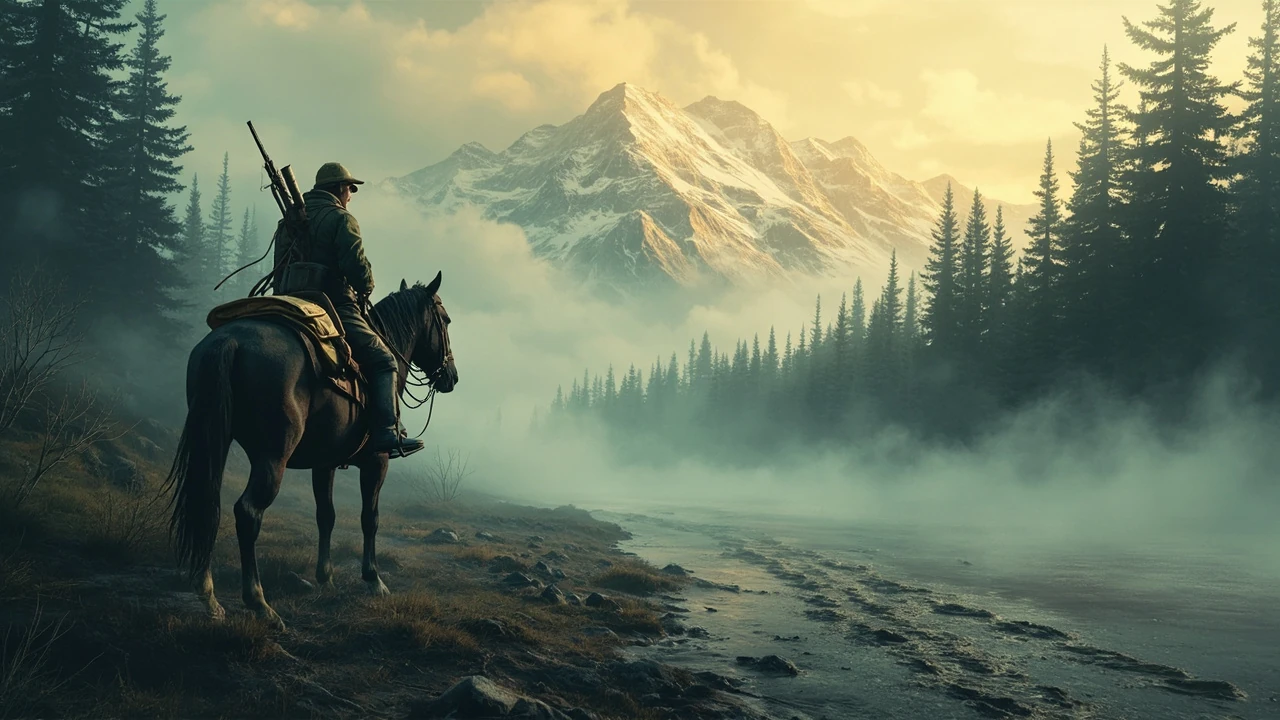
Legendary animals rdr2: a hunter’s reference
Legendary animals in Red Dead Redemption 2 are the most rewarding targets in the open world, and they are also the most misunderstood. Players get the alert in the corner of the screen, follow a yellow glow through Eagle Eye, and then ask the same practical questions: how many clues do I need, can I come back if I die, and what does the pelt actually do once I skin it. This reference is built around those questions, drawing only on confirmed mechanics rather than community hearsay, so a new player and a returning player both get a reliable answer.
The system has three moving parts. First, a three-step clue trail that turns a vague alert into a precise encounter. Second, a hunting phase that punishes the wrong weapon and rewards preparation. Third, a crafting phase where the pelt and the secondary parts are routed to two different merchants, each with a distinct role. Treat the system as a small production pipeline, and the legendary hunt stops feeling like a side activity and starts feeling like a designed progression track.
How the legendary alert works
Every legendary animal is gated by an on-screen alert. When you ride into the rough zone of a target, a message tells you that you have entered the area. The alert is not the encounter; it is a permission slip to start searching. From that point, the trail mechanic takes over, and it behaves the same way for nearly every animal on the list.
The trail is built from three clues. The first clue is the hardest to find because the alert only narrows you to a region. Use Eagle Eye, which is bound to L3 plus R3 on a standard controller, and the screen will gain a sepia tint. While Eagle Eye is active, golden particles rise from interactive objects, and a clue is one of those interactive objects. Read the clue to lock the trail, then look for the next golden particle along the direction the animal moved. Each read narrows the search area until the third clue places you on top of the encounter itself.
One target breaks the pattern. The Legendary Bharati Grizzly Bear in Chapter 2 only needs two clues instead of three. If your trail runs out after the second read, you have not missed anything; the bear is designed to be the first real hunt and the developers shortened the sequence on purpose. The trade-off is that the bear is also one of the most aggressive targets on the list, so a shorter trail is balanced by a harder fight.
Why the chapters matter
Legendary hunts are not all available from the start. Five of them are story-gated, and one is gated by an in-game challenge, which means the order in which you can clear the system is fixed by the chapter you have reached.
- Legendary Grizzly Bear (Bharati): unlocks after the Chapter 2 mission “Exit Pursued By a Bruised Ego”.
- Legendary Alligator (Bullgator): unlocks after the Chapter 4 mission “Country Pursuits”. It may not appear in the world until the start of Chapter 6, so expect a delay between unlocking the mission flag and seeing the alert.
- Legendary Panther: becomes available once you are far enough into the story to reach the south of Lemoyne, gated by a Hunting Challenge that requires several master-tier animal kills first.
- Legendary Cougar: appears as a random encounter rather than a fixed alert and is a separate threat from the legendary set.
- Legendary Elk and Legendary Wolf: appear in northern regions that are unsafe to cross before Chapter 6, so even without a story flag they are functionally story-gated by map access.
Treat chapter progression as the load-bearing prerequisite. The game does not display a checklist, and the only reliable way to know a target is live is to ride into its region and watch for the alert. If the alert never fires, the most common cause is missing a story mission rather than a bug.
Weapon choice and damage rules
Pelt quality does not matter on a legendary target, so the usual “use the right rifle for a clean pelt” rule is replaced by “use the highest damage-per-shot you own”. A sniper rifle or a shotgun is the standard recommendation, with a repeater as a closer-range follow-up. Headshots are still the fastest way to drop the animal, but a legendary will not run away from a wounded pelt the way a normal animal does, so the trade-off is purely about how many shots you get before it reaches you.
Use the terrain before you use the trigger. The boulder trick is part of the intended design for the most dangerous animals: the Legendary Grizzly Bear, the Legendary Cougar, the Legendary Panther, and the Legendary Alligator. A handful of large rocks in each encounter are placed precisely so a player can climb up, fire down, and be unreachable. If you can clear a hunt by kiting the animal into a known boulder, you can finish the entire legendary set with no deaths even on a first playthrough.
The “too much activity” message
One of the most common stuck points is the message “too much activity in the area”. The system is telling you that a random event is currently occupying the legendary region, and the developers chose to suppress the encounter rather than allow two scripted scenes to fight for player attention. Examples of overlapping events include an NPC camp, a bounty hunter convoy, or a stranger encounter.
The fix is to leave the area on horseback, ride for about a minute, and then change the time. The two reliable methods are saving and reloading the manual save, or pitching a camp and sleeping for twenty-four in-game hours. Either action reschedules the random encounter and the legendary alert returns on the next pass through the region.
Respawn rules and recovery
Legendary animals do not respawn once skinned. The encounter is one-shot, and the pelt is one-shot. If you lose the pelt before reaching a merchant, the system has a soft recovery: the lost part appears in the Trapper’s inventory automatically, but you lose the cash you would have earned from selling it. If the animal kills you, it does not respawn either; you need to leave the area, sleep for twenty-four hours, or reload a save to bring the encounter back.
The practical implication is that a single legendary hunt can take more than one attempt. Plan for a death on the first try against the bear, the panther, or the alligator, and accept that the encounter is recoverable. Plan also for a lost pelt if you die mid-fight, and treat the auto-delivery to the Trapper as a safety net rather than a free pass.
What to do with legendary parts
The crafting economy has two merchants and two product lines. The Trapper buys the pelt and uses it to craft a unique set of clothing and accessories. The Fence takes the secondary part (tooth, antler, claw, fang, horn, heart, eye, or tusk) and turns it into a Trinket or a Talisman. A Trinket needs only the animal part; a Talisman also needs a second ingredient, which the game does not always telegraph.
| Item category | Merchant | Output | Notes |
|---|---|---|---|
| Legendary pelt | Trapper | Clothing and gear | Pelt cannot be sold to a butcher |
| Tooth, fang, or claw | Fence | Trinket | One ingredient only |
| Antler, horn, tusk, heart, or eye | Fence | Trinket or Talisman | Talisman needs an extra ingredient |
The two-merchant split is the most common point of confusion for new players. Once you know the rule, the loop is short: ride to the Trapper, sell the pelt, browse the new outfit; ride to the Fence, hand over the secondary part, and check whether the recipe needs a second ingredient before walking away.
The full target set
After Chapter 1, ten legendary animals are available. The list below is built from the confirmed set in Red Dead Redemption 2 and pairs each target with the chapter flag, the rough region, the secondary part, and the resulting item.
| Animal | Region and rough location | Story or challenge flag | Secondary part | Crafted item and effect |
|---|---|---|---|---|
| Legendary Beaver | South of Elysian Pool, west of Van Horn Trading Post, by a large beaver dam | None after Chapter 1 | Tooth | Beaver Tooth Trinket, weapon degradation -10% |
| Legendary Moose | Northeast corner of the map | None after Chapter 1 | Antler | Moose Antler Trinket, health experience +10% |
| Legendary Bharati Grizzly Bear | North of O’Creagh’s Run lake, Grizzlies East | Chapter 2, “Exit Pursued By a Bruised Ego” | Claw | Bear Claw Talisman, health core drain -10% |
| Legendary White Bison | By Lake Isabella, northwest snowy region | None after Chapter 1 | Horn | Bison Horn Talisman, stamina core drain -10% |
| Legendary Bighorn Ram | Near Cattail Pond, west of Valentine, across the river | None after Chapter 1 | Horn | Ram Horn Trinket, double herbs for Thyme, Oregano, Mint |
| Legendary Wolf | Cotorra Springs geysers, Grizzlies East | None after Chapter 1 | Heart | Wolf Heart Trinket, doubled alcohol tolerance |
| Legendary Elk | Hills just east of Bacchus Station, Cumberland Forest | None after Chapter 1 | Antler | Elk Antler Trinket, looted money +10% |
| Legendary Buck | West side of Big Valley, northwest of Strawberry | None after Chapter 1 | Antler | Buck Antler Trinket, pelt quality penalty reduced |
| Legendary Coyote | Dry river bed of Dewberry Creek, northwest Lemoyne | None after Chapter 1 | Fang | Coyote Fang Trinket, Dead Eye experience +10% |
| Legendary Fox | Meadows around Mattock Pond, Lemoyne | None after Chapter 1 | Claw | Fox Claw Trinket, Eagle Eye duration +5 seconds |
| Legendary Boar | Edge of Bluewater Marsh, northeast Lemoyne | None after Chapter 1 | Tusk | Boar Tusk Talisman, horse health and stamina core drain -10% |
| Legendary Bullgator | Bayou NWA, west of Lakay, Lemoyne | Chapter 4, “Country Pursuits”; may not appear until Chapter 6 | Tooth | Alligator Tooth Talisman, Dead Eye core drain -10% |
| Legendary Panther | West of Shady Belle, south of Lemoyne | Hunting Challenge, master tier | Eye | Panther Eye Trinket, Dead Eye drain rate reduced for 3 seconds |
| Legendary Tatanka Bison | Meadows on the east side of New Austin | None after Chapter 1 | Horn | Tatanka Bison Horn Trinket, melee damage taken -10% |
Two notes on the table. First, the regions are written as the in-game landmarks that anchor the alert; once you are in the rough zone, the trail system handles precision. Second, the Legendary Pronghorn is sometimes reported as a confirmed target in older third-party maps, but the data behind this reference did not include a stable region for it, so it has been left out rather than filled in from memory.
Fight tactics for the dangerous four
Three animals account for most of the deaths on a first playthrough: the Legendary Grizzly Bear, the Legendary Panther, and the Legendary Bullgator. The fourth, the Legendary Cougar, is not a fixed legendary target but is a random ambush that can spawn in similar terrain and will kill an unprepared player in two pounces. The tactics are not the same, because each animal’s attack pattern is different.
- Grizzly Bear: takes roughly four sniper rounds to drop. It charges after the first shot. Climb the marked boulders and fire down, or kite it in a wide circle and take shots on the run. The two-clue trail is short, so have a sniper ready before the third clue resolves.
- Bullgator: the highest health pool in the set and a charge that staggers most weapons. Open at long range with a sniper, switch to a repeater or a shotgun as it closes, and use Dead Eye to land the headshot when it is in melee range. The boulder trick is less reliable in the bayou, so the intended strategy is to disengage and re-engage.
- Legendary Panther: ambushes from tall grass and kills in one or two pounces. Apply Covering scent before crossing into its region, and dodge the pounce by aiming with the left trigger and strafing with the left stick plus the dodge button. Panther kills are decided in the first five seconds of the encounter.
- Legendary Cougar (random): behaves like the panther, with the same two-pounce kill window. The same dodge input works, and the same covering scent applies, but the cougar is not a tracked target; it is a world event that patrols the same regions as several legendary alerts.
If you die on any of these, the recovery loop is the same. Leave the region, sleep for twenty-four hours, or reload the save, then re-enter and the encounter returns. The first death is part of the design, not a failure state.
Reading a clue trail in practice
The clue trail is the part of the system that most often goes wrong, and the failure is almost always the same. The player reads a clue, then runs in the wrong direction, and the next clue never appears. The reason is that the trail is anchored to the animal’s last direction of travel, not to a fixed map marker. Once you read a clue, slow down and look at the ground, because the next particle is rarely more than a few meters in the direction the prints are pointing.
- Read the clue text first. Each clue is a short visual log that describes what the animal was doing; the description is a hint about direction, not flavor.
- Look at the tracks leaving the clue. The prints point along the trail. If you walk against the prints, you are walking the wrong way.
- Use Eagle Eye continuously. Without the sepia tint, the next clue particle is almost invisible against grass, mud, and snow.
- Stop running. The trail is short on purpose, and sprinting past a clue resets the read.
- When the third clue resolves, do not move. The encounter spawns at the clue location, and a fast horse will ride straight past the spawn point.
Following the trail slowly is faster than sprinting past it and circling back, because each missed clue costs more time than the walk it would have replaced.
How the legendary set fits into the wider economy
The legendary loop is a parallel economy that runs alongside the main game. Pelts are not currency, but the crafted outfits change how NPCs react to you and how the camp looks, and the trinkets and talismans create permanent stat modifiers. A complete legendary set is therefore less about money and more about build tuning: a player who finishes the elk and the buck has a small but persistent bonus to loot and pelt quality that affects every other hunt in the game.
Two effects are worth designing your route around. The Buck Antler Trinket, which reduces the pelt quality penalty for wrong-weapon kills, is the single biggest quality-of-life unlock in the system. The Boar Tusk Talisman, which lowers horse health and stamina drain, is the most impactful survivability unlock for players who plan to keep a single horse through the late game. If you hunt in the order that unlocks those two first, the rest of the set becomes easier.
How the system changes between normal and post-game
After the main story ends, the legendary system does not restart. Skinned animals stay skinned, and the Trapper and Fence inventories hold the same crafted pieces. What does change is the surrounding world: random events rotate more freely, bounty hunter ambushes become more common, and the “too much activity” message fires more often in the late game because there are more concurrent encounters in the world.
The practical adjustment is the same as in the early game. If the alert does not fire, ride out of the region, save and reload, or camp for twenty-four in-game hours. The legendary encounter is on a fixed schedule in the world simulation, and the schedule is decoupled from the chapter flag that originally unlocked it.
Frequently asked questions
How many legendary animals are in rdr2 after Chapter 1?
Ten are available once you finish Chapter 1, including the Legendary Bharati Grizzly Bear in Chapter 2 and the Legendary Bullgator after Chapter 4. The Legendary Panther requires a master-tier Hunting Challenge. Older community lists sometimes include the Legendary Pronghorn, but the underlying data behind this reference did not confirm a stable region for it, so treat any claim about that target as unverified until you see the alert in your own game.
Do legendary animals respawn in rdr2?
No. A skinned legendary does not return in the same playthrough, and the pelt is one-shot. If the animal kills you, leave the area and either sleep for twenty-four in-game hours or reload a save, and the encounter returns. If you lose the pelt before reaching a merchant, the system auto-delivers it to the Trapper, but you lose the cash you would have earned from selling it.
Why does the game say “too much activity in the area”?
The system suppresses the legendary alert when a random event is already occupying the region, such as a stranger encounter, a bounty hunter convoy, or an NPC camp. The fix is to ride out of the area, save and reload, or camp and sleep for twenty-four in-game hours. The legendary alert returns on the next pass.
What is the best weapon for legendary animals in rdr2?
A sniper rifle for the opening shots, then a repeater or a shotgun for the closing distance. Pelt quality does not matter on legendary targets, so the rule is to use the highest damage-per-shot you own rather than a small-game rifle.
Where do I sell legendary pelts in rdr2?
The Trapper buys the pelt and uses it to craft clothing and accessories. The Fence takes the secondary part and uses it to craft Trinkets and Talismans. The pelt cannot be sold to a butcher.
What is the difference between a Trinket and a Talisman in rdr2?
A Trinket needs only the animal part. A Talisman also needs a second ingredient, which the game does not always telegraph in the recipe. The Bear Claw Talisman and the Boar Tusk Talisman are the most impactful Talismans in the set, and both require an extra crafting material at the Fence.
How do I dodge a cougar or panther pounce in rdr2?
Aim with the left trigger and press the dodge input, which is left or right on the left stick plus the dodge button. The dodge has a brief invulnerability window, and timing the dodge to the moment the animal launches is the difference between a one-pounce kill and a clean counter.
Is the legendary hunt possible before Chapter 2?
The alert for the Legendary Bharati Grizzly Bear only fires after the Chapter 2 mission “Exit Pursued By a Bruised Ego”. The other chapter-1 animals are technically available, but the regions required to reach them are blocked by story progression. The intended first hunt is the bear, and the system is built around that order.
Do I need Covering scent for legendary animals in rdr2?
It is not required for every target, but it is the intended preparation for the Legendary Panther, and it helps against the Legendary Cougar random encounter. Applying it before crossing into the alert zone is a cheap insurance policy against an ambush from tall grass.
What is the fastest route to finish the legendary set?
Start in Chapter 2 with the Bharati Grizzly Bear, then sweep the Grizzlies for the Wolf, the White Bison, and the Moose. Move into Cumberland Forest and Big Valley for the Elk and the Buck, then push into Lemoyne for the Coyote, the Fox, the Boar, and the Bullgator once Chapter 4 is complete. Finish with the Panther, the Tatanka Bison, and the Bighorn Ram. The order is not strict, but the chapter flags are.
Leave a Reply