
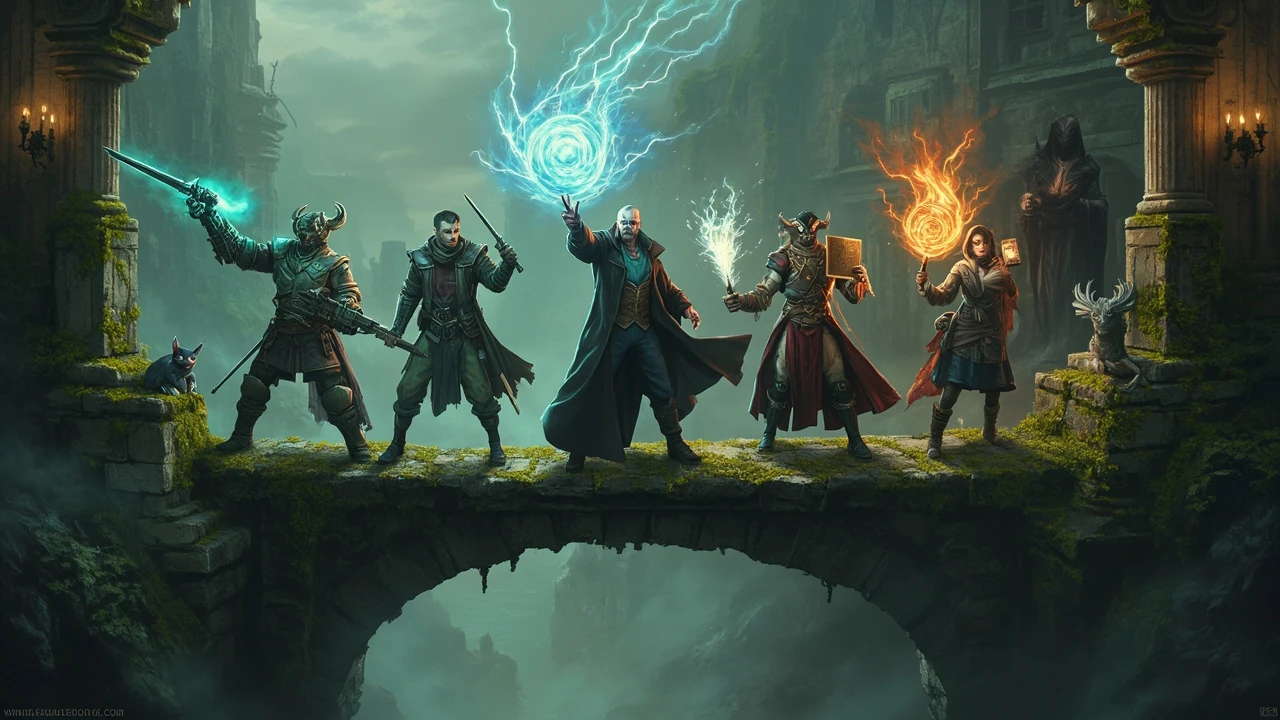
Expedition 33 characters: how the party system shapes your build
Choosing between Expedition 33 characters is the single most important tactical decision you will make on a run. Clair Obscur: Expedition 33, developed by Sandfall Interactive, ships with a roster of six playable adventurers, but you can only bring three into any given fight. Because the game is a turn-based RPG, your active three determine your damage profile, your sustain, your crowd control, and how you react to boss-specific mechanics. Two parties using the same three characters can play like completely different games depending on equipment, ability selection, and stance setup.
This guide focuses on what each Expedition 33 character actually does in combat, how their mechanics interact with the rest of the roster, and the practical decisions you will face when you build a party. We will look at the four characters that the available character guide on Gamerall covers in detail, then discuss how the remaining two fit into the wider system, what the early-game weapon unlocks can do for each kit, and the most common trade-offs players run into when optimizing their active three.
What every Expedition 33 character shares
Before going through the roster, it helps to understand the underlying rules that apply to all Expedition 33 characters. The shared framework is what makes party composition feel like a design problem rather than a list of “best characters.”
- Active party size: exactly three characters in any fight, drawn from a six-character roster.
- Ability slots: each character can equip a limited number of abilities, typically around six, so selection is a real constraint rather than a theoretical one.
- Pictos and Lumina: Pictos are learnable combat bonuses that characters can carry, enabled in the story by Gustave’s Lumina Converter. This system lets you mix and learnable effects across the party.
- Stance and resource systems: Maelle, Lune, and Sciel each use a distinct resource engine (stances, elemental stains, Sun and Moon charges) that defines their rotation. Other characters use simpler loops.
- Action Points (AP): most powerful abilities cost AP, so managing AP economy is shared across the entire party.
Those shared rules explain why the question of “which Expedition 33 character is strongest” is less useful than “which three Expedition 33 characters solve this fight.” A character who feels weak in isolation can become central to a team that supplies what they need.
Gustave: the balanced anchor with a powerful trump card
Gustave is the party’s engineer and the character who gives the team its equipment backbone early on. According to the available character guide, he is the one responsible for the Lumina Converter, the device that allows other characters to equip Pictos after learning them in combat. Mechanically, that means unlocking Gustave’s story beat has a direct effect on how every other member of the roster can be customized.
In combat, Gustave uses a sword and a gun, but his most distinctive feature is the mechanical arm on his weapon set. The arm can be “overcharged” to deliver a heavy single-target blow capable of taking chunks out of enemy health bars, including eliminating some enemies in one hit. The guide notes that his ability set is more limited than the other Expedition 33 characters, partly because of later story constraints, but a few of his abilities stand out and reward investment.
Statistically, Gustave is described as well-rounded, with respectable HP, attack power, and speed. His main weakness is a lower critical hit rate compared to the rest of the roster, but the trade-off is that some of his abilities reward crits with extra Overcharge stacks. That means a player who learns to feed him crit-rate Pictos or who times abilities into his own Overcharge windows can push his damage higher than his raw stats suggest. He is also voiced by Charlie Cox, for players who track that side of the production.
When to bring Gustave
Gustave is strongest in the early game and remains useful in fights where a single hard-hitting attack is more valuable than sustained combos. He also stays relevant in story sections where the team is restricted to specific members, because his utility does not depend on multi-turn setup. In a free-form party, he tends to fill the “reliable damage plus enable” slot: he can set up Overcharge, spend it, and pass turn economy to a damage carry like Maelle.
Maelle: the stance-based damage carry
Maelle is the most damage-oriented of the Expedition 33 characters covered in the guide. She begins the story as Gustave’s foster sister, and her combat identity is built around a rapier and a stance system. The stances are:
- Virtuose Stance, the high-damage stance that powers her biggest single-target and AoE abilities.
- A defensive stance, used to peel pressure and to bridge turns.
- A utility stance, used for stance preservation and resource manipulation.
What makes Maelle special is that she is one of the most efficient damage dealers in the roster, to the point that the developers have tuned her down more than once. The guide points out that one of her abilities, Stendhal, was at one point able to deal more than 100 million damage in a single use, which is why the ability now sits behind a heavier AP cost and the rest of the cast was tuned against that ceiling. Even without trying to break the game, Maelle performs well. Her Burning Canvas ability hits especially hard against enemies afflicted with burn, which is the type of synergy that defines her role in a party.
The Medalum weapon and why it matters
The single biggest early-game upgrade for Maelle is the Medalum rapier. The guide describes a specific path to obtain it: defeat the final boss in the Gestral Village Arena, called “The Stranger,” while playing as Maelle. If you win the bout as Maelle, she is rewarded with the Medalum.
The reason the Medalum is so important is that it changes her opening tempo. Maelle often begins a fight without any special stance active. With Medalum equipped, she starts the fight in Virtuose Stance, which means she can unload her highest-damage skills on turn one rather than spending a setup turn. That single weapon move shifts her from “good carry with setup” to “carry who can end a vulnerable phase on the first action.”
Sample turn order for Maelle
Because ability slots are limited, the guide offers a concrete turn plan that is worth understanding even if you eventually tune it to your own playstyle. With Medalum equipped and Stendhal available, you can use Fleuret Fury on the first attack to preserve Virtuose Stance for the second turn, letting another character apply burn and other status effects in between. If you do not have enough AP for a key ability, the Mezzo Forte ability preserves the current stance while refunding two to four AP, which can be re-spent on a high-AP finisher like Phantom Strike. This kind of “preserve, refund, finish” loop is what makes Maelle’s kit feel designed rather than improvised.
On the production side, Maelle is voiced by Jennifer English, a casting choice that the guide notes is relevant for players who recognize her from other RPG roles.
Lune: the spellcaster with a complex elemental setup
Lune is the party’s dedicated mage, but calling her a straightforward caster undersells her design. She can be built as a heavy damage dealer using elemental magic, or as a healer using spells like Healing Light (which also dispels negative status effects), Rebirth (to revive fallen allies), and Revitalization (to apply Regen on active party members). That flexibility is real, but it comes at the cost of a steeper learning curve than the other Expedition 33 characters.
The core mechanic is a system of elemental “stains.” Several of Lune’s abilities apply elemental stains, and her most powerful spell, Elemental Genesis, requires her to have collected four of them: Lightning, Fire, Cold, and Earth. When all four are active, Elemental Genesis hits all enemies eight times, which is one of the strongest AoE payoffs in the game.
How to actually trigger Elemental Genesis
The fastest route to a full stain set uses the level-10 or higher Betelim weapon combined with the Elemental Trick ability. Elemental Trick applies a random set of stains, which in most cases is enough on its own. If you still need a specific element, you can target it directly: Ice Lance for an Ice Stain, Lightning Dance for a Lightning Stain, Crustal Crush for an Earth Stain, and Fire Rage for a Fire Stain. Each of these abilities also applies a Light Stain, and Light Stain can substitute for any element when casting a higher-tier spell. With that in mind, the guide notes that Elemental Genesis can realistically be used on the second turn of a fight, provided the right conditions are met.
Unlocking the Betelim weapon
The Betelim is gated behind a small chain of story tasks rather than a single boss. To obtain it, you have to rescue four Lost Gestrals, which unlocks the ability to destroy Paint Spikes. Once that is possible, head to Gestral Village and locate the Paint Spike near the houses outside the Gestral Arena. The weapon is the practical prerequisite for an Elemental Trick–focused Lune build, so it is worth clearing that chain before committing to her as a damage carry.
Why Lune feels harder than she looks
The guide is direct about the difficulty curve. Lune’s most powerful abilities are late-game, so if you slot her in early she is going to feel underwhelming if you build her as a pure damage dealer. The recommendation is to use her as a healer at the start, then transition her toward elemental damage once you have both the Betelim and her better abilities. That arc is part of why she rewards planning more than reaction.
Sciel: the support who scales into a finisher
Sciel looks like the most average member of the cast on the surface, but the available guide argues she is one of the strongest Expedition 33 characters once you understand her Foretell mechanic. The mechanic is built around two complementary charge types.
- Skills that apply Foretell generate a Sun Charge.
- Skills that consume Foretell generate a Moon Charge.
- Having both a Sun and a Moon Charge at the same time activates Twilight Mode, which unlocks her biggest payoffs.
Twilight Mode is the window in which Sciel performs at her peak. The guide describes the setup as a ten-stack plan: build ten stacks of Foretell on the enemy using Sun-charging skills such as Focused Foretell (which applies five stacks when an enemy has none) and Card Weaver (which propagates an existing Foretell stack to all enemies). Once you have ten stacks, switch to a Moon-charging ability like Dark Wave for AoE pressure or Sealed Fate for a hard single-target hit to enter Twilight.
How to use the two Twilight turns
Twilight Mode only lasts two turns, so the rotation is tight. The pattern recommended for experienced Sciel players is to spend the first Twilight turn on Marking Card, which applies a Mark to the target and makes them take 50 percent more damage from your next attack. Spend the second turn on the strongest single-target option available, usually Sealed Fate for bosses or Dark Wave for grouped enemies. This converts Sciel from a slow setup character into a hard carry for two specific turns, which lines up well with bosses that cycle through vulnerable phases.
The Litheson weapon and Act 3 setup
For players who want Sciel in a support role, the guide flags a weapon called Litheson that can be obtained by killing the Lumiere Citizen in the Central Plaza in Act 3. The Litheson allows Sciel to buff allies with a “Greater” effect (the text was truncated in the source, but the intent is a party-wide buff tied to her Twilight timing). For parties that need a dedicated buffer alongside a damage carry, this is the relevant unlock.
The remaining two Expedition 33 characters
The available character guide covers Gustave, Maelle, Lune, and Sciel in detail. The other two Expedition 33 characters round out the six-character roster, and a few production details and party-fit notes are worth knowing even when the deep-dive coverage is thinner.
Why the rest of the roster still matters for party building
Even with only partial coverage, the second pair of Expedition 33 characters tend to fulfill roles the core four do not. A common structure for the missing slots is a dedicated tank or a specialist who can apply debuffs the rest of the party cannot. The reason this matters is that, in a turn-based RPG, stacking three pure damage characters is usually weaker than a balanced trio, because you still need a way to absorb burst, survive phase transitions, and apply the right debuffs to extend the damage window.
General guidance for any unverified roster slot
Because the available source is limited to four characters, the safest approach is to treat the rest of the roster with the same evaluation framework the guide applies to the other four.
- Identify the resource engine. If the character uses a stance, charge, stain, or cooldowns, learn the build-up cost before evaluating the payoff.
- Check the early weapon. Almost every strong character build in the guide is gated behind a specific weapon with a clear acquisition path.
- Read the late-game abilities. The guide is explicit that Lune in particular only becomes a carry with late-game unlocks, and that pattern is common in turn-based RPGs.
- Test in a free slot first. With six Expedition 33 characters and three active slots, you can experiment without resetting a save.
This framework prevents the common mistake of judging a character by their tutorial role rather than their late-game ceiling.
How to build a three-character party from the available roster
Once you understand the four well-documented Expedition 33 characters, party building becomes a small set of decisions rather than a long list. The guide’s evidence supports three credible party archetypes, with clear trade-offs for each.
Archetype 1: damage carry plus setup
This is the pattern the guide uses as its main example. Pair Maelle with one or two characters who can apply burn, mark, or other preconditions before Maelle’s burst turn. The opening sequence typically looks like this:
- Character A applies burn or another damaging status effect.
- Character B sets up Overcharge, Foretell stacks, or a Mark.
- Maelle, ideally in Virtuose Stance via Medalum, spends the third turn on a high-AP finisher like Stendhal or Phantom Strike.
What this archetype gains is the ability to end fights on a single turn. What it sacrifices is consistent turn-two pressure, because the first two turns are usually setup turns.
Archetype 2: hybrid elemental pressure
Build around Lune as the AoE backbone, with the other two slots used to support her stain economy or to clean up targets that survive Elemental Genesis. The guide’s own description of using Elemental Trick to skip setup and then casting Elemental Genesis on the second turn is a complete rotation in itself. Pairing Lune with a character who can apply Mark or Foretell before her burst turn, or with a healer for the fights where sustain matters more than burst, is the practical way to use her.
Archetype 3: balanced frontline with utility
Use Gustave as the reliable damage plus enable option, with two characters who cover his weak points. This archetype shines in longer fights, in story-locked parties, and in encounters where you need AP sustain more than single-turn burst.
| Archetype | Core character | Strength | Trade-off |
|---|---|---|---|
| Damage carry plus setup | Maelle with Medalum | Highest single-turn burst, can end a phase | Slow first turns, depends on setup characters |
| Hybrid elemental pressure | Lune with Betelim | Reliable AoE via Elemental Genesis, scales late | Late-game power spike, weaker early |
| Balanced frontline with utility | Gustave with Overcharge | Consistent damage, enables Pictos access for the team | Lower crit rate, fewer abilities |
Ability slot management: the real constraint behind every build
The guide repeatedly emphasizes that you can only equip a limited number of abilities per character, around six in the cases described. That single rule changes how you read every recommended build, because a strong ability list is also a small one. Two practical rules follow from this constraint.
- Pick abilities by role, not by raw damage. You will usually want one or two setup abilities, one or two spenders, and at least one stance or resource tool.
- Carry one fallback. Every recommended build in the guide includes a “preserve” or “refund” option like Mezzo Forte, because fights rarely go as planned and the ability to skip a turn without wasting tempo is real value.
AP economy: why refund abilities matter
Action Points are the shared resource that gates every big ability. The guide’s description of Mezzo Forte returning two to four AP while preserving Maelle’s current stance is the clearest example of why AP economy is a first-class concern. The same pattern appears implicitly in Sciel’s two-turn Twilight rotation: the first turn is “cheap setup” and the second is “expensive payoff,” which only works if you can bank the right resources in between.
| Resource | Who spends it | Typical cost or shape | Refund option mentioned in the guide |
|---|---|---|---|
| Action Points (AP) | All Expedition 33 characters | Gated on powerful abilities like Phantom Strike and Stendhal | Mezzo Forte refunds 2 to 4 AP while preserving stance |
| Stance | Maelle | Virtuose, defensive, utility |
Weapon acquisition paths at a glance
The most efficient way to plan your early game is to set up the weapon paths for the Expedition 33 characters you intend to use. The available source confirms three weapon paths directly.
| Character | Key weapon | How to obtain it | Effect on the build |
|---|---|---|---|
| Maelle | Medalum | Defeat “The Stranger” in the Gestral Village Arena while playing as Maelle | Start fights in Virtuose Stance, enabling turn-one burst |
| Lune | Betelim (level 10 or higher) | Rescue four Lost Gestrals to unlock Paint Spike destruction, then find the Paint Spike near the houses in Gestral Village | Enables the Elemental Trick route to Elemental Genesis |
| Sciel | Litheson | Defeat the Lumiere Citizen in the Central Plaza in Act 3 | Allows Sciel to buff allies with a Greater effect |
How voice and narrative shape character choice
The guide’s voice cast notes are a small but useful reminder that character choice in Expedition 33 is not purely mechanical. Maelle’s connection to other RPGs through Jennifer English’s casting, and Gustave’s link to a well-known actor in a different genre, are signals that the writing team is aiming for emotional beats rather than a pure power curve. For players who care about narrative delivery, it is worth considering whether a character’s story arc fits the moment you are about to play through before you commit them to your active three.
Common mistakes when evaluating Expedition 33 characters
Most of the pitfalls when judging Expedition 33 characters come from treating the tutorial version of a kit as the final version. A few patterns are worth avoiding.
- Judging Lune before her late-game abilities. She is a healer first, damage carry later, and treating her otherwise leads to a stalled early game.
- Ignoring weapon gates. Maelle without Medalum and Lune without Betelim are functional, but not the characters the build guides describe.
- Over-indexing on raw damage. Sciel, Lune, and Gustave all enable other characters, and the enablement is often more valuable than the personal damage number.
- Forgetting that ability slots are limited. Filling all six slots with high-cost abilities leaves no room for the preserve or refund options that keep a rotation alive.
How this page handles the limits of the source
Only one external source was supplied for this page, and that source covers four of the six Expedition 33 characters in detail. The article therefore treats Gustave, Maelle, Lune, and Sciel as fully supported, and treats the remaining two characters as a roster gap. Where the source was truncated, like the description of the Litheson’s Greater effect, the article flags the limit rather than inventing a detail. Specific numbers that were not present in the source, such as exact HP values, critical rates, or AP costs, are described qualitatively rather than as fabricated figures. The single external link points to the Gamerall character guide that contains the underlying coverage.
Related reading from the Zelvorn Studios blog
For more on how character-driven design and progression work in other RPGs and action games, two existing articles on the site dig into comparable systems.
Frequently asked questions
How many Expedition 33 characters can you play as?
There are six playable Expedition 33 characters in total. You can only bring three of them into any given fight, so party composition is the core tactical decision in the game.
Who is the best Expedition 33 character for damage?
Maelle is the strongest dedicated damage carry among the Expedition 33 characters covered in detail, especially when she starts a fight in Virtuose Stance via the Medalum weapon. Her Stendhal ability was at one point capable of more than 100 million damage, which is why the developers have tuned her other abilities around that ceiling. Even without chasing that edge case, she performs well in standard play.
Is Gustave worth using after the early game?
Yes. Gustave has fewer abilities than some of the other Expedition 33 characters, but his Overcharge mechanic and his role in unlocking the Lumina Converter make him useful throughout a playthrough. He also fits story sections where party options are restricted.
How do you get the Medalum for Maelle?
Defeat the final boss in the Gestral Village Arena, named The Stranger, while playing as Maelle. Winning as Maelle rewards you with the Medalum, which lets her start fights in Virtuose Stance.
How do you get the Betelim for Lune?
Rescue four Lost Gestrals to unlock the ability to destroy Paint Spikes. Then go to Gestral Village and find the Paint Spike near the houses outside the Gestral Arena. The Betelim is the weapon that makes Lune’s Elemental Trick rotation work.
Why is Lune hard to use at first?
Lune’s biggest payoffs, like Elemental Genesis, are late-game abilities. She has a full healing kit available early, including Healing Light, Rebirth, and Revitalization, so the recommended approach is to use her as a healer at the start and then transition her into an elemental damage carry once her better abilities and the Betelim are unlocked.
What is Foretell in Sciel’s kit?
Foretell is the central resource in Sciel’s kit. Skills that apply Foretell generate a Sun Charge, and skills that consume Foretell generate a Moon Charge. When Sciel has both charges active at the same time, she enters Twilight Mode, which gives her two high-impact turns. The guide recommends stacking ten Foretell stacks before entering Twilight and using Marking Card on the first Twilight turn to make the next attack deal 50 percent more damage.
Can you respec or change ability loadouts for Expedition 33 characters?
The available source confirms that ability loadouts are limited, with about six ability slots per character, but it does not detail a respec system. Treat ability selection as a real choice and avoid locking in a full high-cost list before you have tested the kit.
What is the fastest way to unlock a strong party in Expedition 33?
The most efficient early path is to clear the Gestral Village Arena as Maelle for the Medalum, rescue the four Lost Gestrals for the Betelim path, and use the standard three-character party you take through the early chapters to learn each kit’s resource engine before you specialize.

Leave a Reply