
MK11 forge recipes: how the crafting system actually works in Mortal Kombat 11
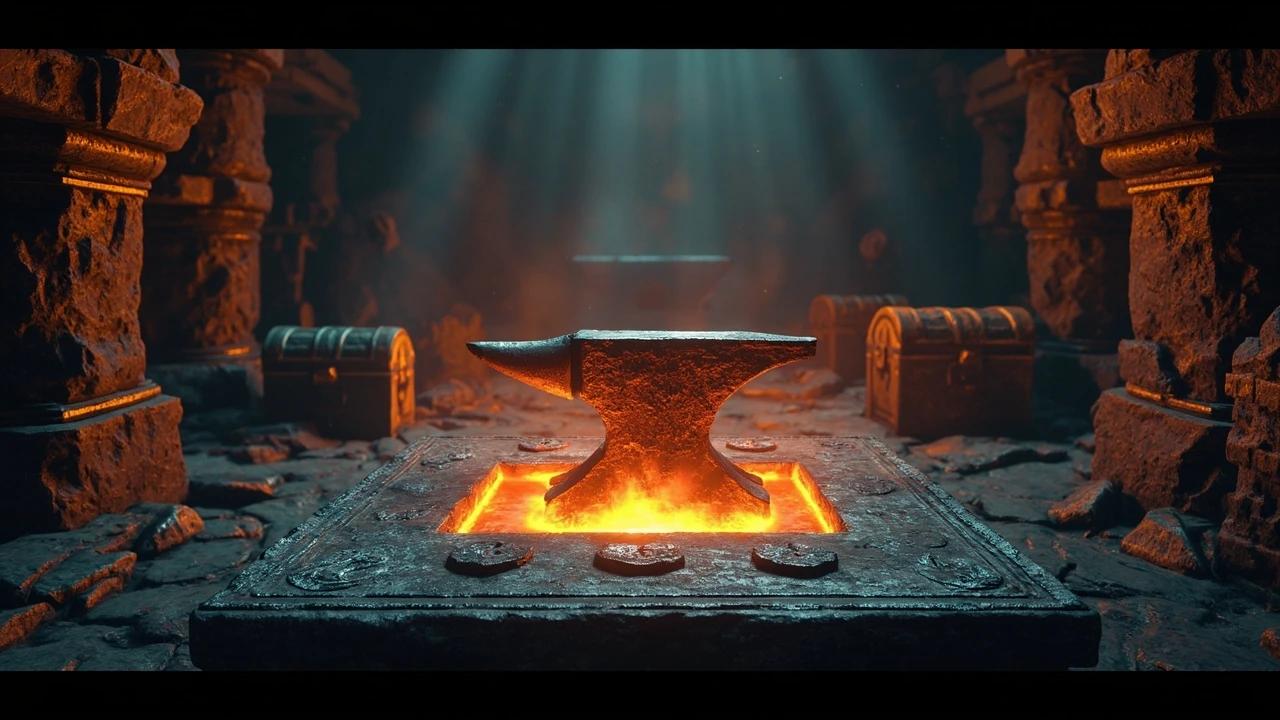
When most players first walk into the Krypt in Mortal Kombat 11, they stumble into a large, lava-lit Forge room that is never properly explained by the game itself. The anvil sits there, slots glow, and a small menu invites you to combine items, but the rules, costs, and outcomes are almost invisible until you read a recipe scroll or stumble into a chest that hands one to you. The result is that mk11 forge recipes quickly become one of the most searched topics in the game’s community, because the system feels obscure even after dozens of hours of play.
The Forge is essentially a three-slot crafting station that lets you combine up to three Forge Items into a single new item, usually a Konsumable that can be used in the Towers of Time, Klassic Towers, or other modes where you need a temporary edge against a difficult opponent. Each item you slot has its own rarity and its own crafting cost, and the total cost of the resulting item is the sum of every cost shown in the slots, not a flat fee. That single mechanic is the source of most player confusion, because a recipe that looks cheap in a screenshot can quietly cost 20,000 Koins and 500 Soul Fragments once the high-tier components are added together.
This reference walks through the verified information available about how the Forge operates, what the known item categories are, what crafting costs to expect, and how the recipe scrolls themselves are found. It also covers the practical editing decisions a guide writer or wiki contributor has to make when documenting a system whose in-game explanation is sparse. Because the game does not publish a complete formula sheet, every figure below comes from a single authoritative external reference on the topic, and where that source stops, the limitation is stated rather than filled in from memory.
What the MK11 Forge actually is, and why it exists in the Krypt
The Forge is one of the central interactive set pieces in Mortal Kombat 11’s Krypt, sitting near the heart of Shang Tsung’s island fortress. It looks decorative at first glance, but it is the only way to turn raw Forge Items into useful Konsumables, augments, and currency items that matter for the rest of your playthrough. The game frames it as a Shao Kahn-era relic, but functionally it behaves like a generic three-slot crafting bench that other action games have used for years.
The reason the Forge feels mysterious is that Mortal Kombat 11 does not provide a built-in crafting manual. You will not find a tutorial pop-up explaining slots, costs, or even the existence of recipe scrolls. Instead, recipes are handed out through random chest drops scattered around the Krypt, and each scroll only names the three components you need, not the exact order in which they must be slotted. That design choice is what makes the system feel expensive and inconsistent, because players who never see a recipe scroll end up combining items at random and burning through Koins, Hearts, and Soul Fragments in the process.
For a guide writer, the editorial challenge is that the Forge exists in a game that does not show its own data clearly. You have to look at external wikis to know that the basic cost tiers exist, that recipes can be partial, and that chest re-sealing is an intended mechanic rather than a bug. Once you accept that the source material is community-validated rather than developer-documented, the system’s logic becomes much easier to describe.
How MK11 forge recipes are discovered and stored
Recipes are not unlocked automatically. You only learn a new mk11 forge recipe when you open a chest that contains its associated recipe scroll. When you pick up the scroll, the recipe is added to the Kollections tab inside the Kustomize menu, where it remains available for the rest of that playthrough. Importantly, a recipe scroll does not consume the items you will later use to craft the result; it only records the formula, which is why the same scroll can be used as many times as you can supply the ingredients.
The official guidance from external documentation is that chests “sometimes don’t give the full list of ingredients” but will instead hand you one or two of the items that the recipe needs. That partial-drop behavior is a key part of how the system is designed, because it forces you to keep opening chests even after you have learned the recipe. It is also why players who rush straight to the Forge without exploring the rest of the Krypt end up with a stockpile of items they cannot use, and no idea which chest will give them the rest of the missing pieces.
Recipes can be re-discovered through a second, less obvious mechanic: any chest that previously gave you a recipe or a recipe component can be reverted to an unopened state by using Kronika’s Time Vault and paying Koins. This effectively re-rolls the chest, which is useful when you know a chest once held a recipe but the most recent open only gave you consumables. The Time Vault is the only sanctioned way to retry a chest, so it is the only way to recover a missed recipe without restarting the Krypt.
The three-slot interface and how ingredient cost is calculated
When you walk up to the Forge, you can place up to three items into the interface at once. Each item has its own rarity tier and its own cost, and the total cost shown in the result window is the sum of the three. The system does not show a flat crafting fee, nor does it refund ingredients if you cancel the craft, so misclicks are punished. That is why most players treat the Forge like a real crafting station: they gather the required items first, then craft in batches rather than experimenting.
The cost tiers that show up in the result window fall into two distinct ranges. Basic recipes use the low-cost tier, which is the most common one you will see while clearing the early Krypt and grinding the Central Courtyard. Specialized recipes, especially those used to craft the most powerful augments and consumables, sit in a much higher cost tier that most players will only see after dozens of hours of farming.
| Cost tier | Koin cost | Soul Fragment cost | Heart cost | Typical use |
|---|---|---|---|---|
| Basic | 400 Koins | 20 Soul Fragments | 4 Hearts | Common augments, low-tier Konsumables, simple utility items |
| Specialized | 20,000 Koins | 500 Soul Fragments | Not typically used | Rare augments, high-end Konsumables, late-game items |
The table reflects the two published cost brackets, not a smooth scale, which is itself a useful design observation: the game treats the Forge as a binary system, where you are either spending pocket change or committing to a major crafting project. There is no documented intermediate tier, so any guide that quotes an in-between number should be treated with suspicion.
Where the ingredients and recipe scrolls come from
Forge Items and recipe scrolls are both obtained from chests, but they are not the only source. The most reliable early-game source of ingredients is the Central Courtyard, where lava rocks fall from the sky on a roughly four-to-five minute cycle. Breaking those rocks with an attack yields a mix of Forge Items, Hearts, and occasional Koins, which makes the Courtyard the standard farming spot for any serious crafter. The cycle is short enough that you can plant your character near the rocks, attack on spawn, and walk away to open chests while you wait for the next drop.
Beyond the Courtyard, every other ingredient source in the Krypt is some form of chest interaction. There are chests hidden behind breakable walls, locked behind platforming puzzles, gated by specific key items, and dropped by Shao Kahn’s statue events. Because the Krypt is large and the spawn points are not labeled in-game, most players end up following a chest-route map from the community rather than improvising.
The Time Vault adds a second layer to this economy. By paying Koins to a chest you have already opened, you can re-seal it and try the contents again, which is the only way to target specific recipes without restarting the Krypt or reloading a save. The cost of using the Time Vault is small compared to the value of the recipe you might recover, so experienced players treat it as part of the normal crafting flow rather than a last resort.
How MK11 forge recipes are organized in the Kollections tab
Once a recipe scroll is opened, the formula is stored in the Kollections tab of the Kustomize menu, alongside concept art, character bios, and other unlocks. Recipes are listed as small icons with a name and the three component slots they require, but the Kollections tab does not show you where to find the components or how much the final craft will cost. To know the cost, you have to slot the items into the Forge itself, which means the Kollections tab is best understood as a recipe book rather than a crafting calculator.
For a guide, this distinction matters. Listing every known recipe as a row in a table is useful, but listing the cost in that table is misleading unless the cost was actually observed in the game, because the Kollections tab does not surface it. The right place to confirm cost is at the Forge, which is why this reference treats cost as a separate piece of data from the recipe itself.
There is no public developer confirmation of how the recipe list is ordered in the Kollections tab, only community observation that it generally follows a tier-based grouping. Treat the order as a UI convenience rather than a hard game rule.
Verified MK11 forge recipes and what they produce
The following table lists the recipes that are publicly documented in the referenced guide, with the three component items each one requires. The cost column is the cost bracket from the earlier section, not a per-recipe number, because the source material only confirms the bracket, not a unique cost for each recipe. Anything that is not on this list should be treated as unverified.
| Recipe | Component 1 | Component 2 | Component 3 | Cost bracket |
|---|---|---|---|---|
| Augment Augment Augment | Augment | Augment | Augment | Basic |
| Soul Fragments (×100) | 10,000 Koins | 50 Soul Fragments | — | Basic |
| Konsumable: Random | Random Forge Item | Random Forge Item | Random Forge Item | Basic |
| Elemental Stone | Earth Vial | Fire Vial | Ice Vial | Specialized |
| Shao Kahn’s Helmet | Shao Kahn’s War Hammer | Shao Kahn’s Chest Plate | Heart of the Fortress | Specialized |
| Heart of the Fortress | Dragon Insignia | Ruby | Sapphire | Specialized |
Two practical notes about the table. First, the second row uses a two-slot recipe, which is the only confirmed deviation from the three-slot standard and is the exception rather than the rule. Second, “Augment Augment Augment” is the cheapest documented recipe and exists primarily to let you turn low-value augments into a single higher-value augment, which is the most common use of the basic cost tier.
For a designer reading this list, the obvious pattern is that the game clusters recipes by function: currency recipes, random Konsumable recipes, augment recipes, and lore recipes tied to Shao Kahn. Once you accept that grouping, the system becomes much easier to learn because you can roughly predict which cost bracket a recipe will fall into just by looking at what it produces.
Why the system feels more expensive than it actually is
A frequent complaint from new players is that the Forge “wastes” their resources, but the underlying issue is rarely the costs themselves. The two most common sources of waste are players combining items before they have the matching recipe scroll, and players using high-tier ingredients to fill the wrong slot in a three-slot recipe. Both of these mistakes are expensive because the system does not refund components on cancel, and the high-tier tier costs ten thousand Koins or more per craft.
Reading the recipe scroll before opening any chests is the simplest way to avoid the first mistake. The second mistake is harder to avoid without external documentation, because the in-game slots do not label which items are intended for which position in a recipe. Treating the three slots as interchangeable, rather than assuming the order shown in the Kollections tab matters, is a safer mental model.
For guide writers, the editorial takeaway is that any article on mk11 forge recipes has to include a workflow section, not just a recipe list. The recipe list alone tells the reader what to craft, but not when, in what order, or how to avoid burning through resources in the process. The workflow is what makes the system usable.
A practical workflow for using the Forge without wasting resources
The most reliable approach, supported by the published source material, is to clear the Krypt in a careful order rather than rushing to the Forge as soon as you find it. The workflow below is the one most consistently recommended by community documentation, and it works because it minimizes the number of recipes you craft without the matching scroll.
- Explore the Krypt in one full sweep, opening every chest you can reach without spending major key items.
- Read every recipe scroll as you find it, and check the Kollections tab after each one to confirm it registered.
- Farm the Central Courtyard for at least one full lava-rock cycle before any major crafting, so you have a surplus of Hearts and low-tier Forge Items.
- Only craft basic-tier recipes in your first Krypt session, to learn how the cost brackets feel in practice.
- Use Kronika’s Time Vault to re-seal any chest that you suspect still holds a recipe scroll or a missing high-tier component.
- Save the specialized recipes for the second half of the Krypt, once you have the Koins and Soul Fragments to absorb a 20,000-Koin mistake.
This workflow is not a developer-recommended path. It is a synthesis of the published Forge guide, the chest-re-seal mechanic, and the documented cost tiers, intended to give a new player a defensible order of operations. The workflow is the kind of editorial scaffolding that the game itself does not provide.
Common pitfalls when reading or writing about MK11 forge recipes
Three pitfalls show up often in player-written references and they are worth flagging because they affect how trustworthy any given guide looks.
- Inventing costs. The game only publishes the two cost brackets, so any guide that lists a unique cost for a specific recipe has either pulled the number from a private test or has made it up. Treat unique per-recipe costs as red flags.
- Listing recipe components in the wrong order. The three-slot system does not require a specific order, but the Kollections tab visually presents the slots in a fixed order. Writers who assume the order matters will mislead readers into thinking the order is enforced, which is not the case.
- Treating the Time Vault as a glitch. Re-sealing chests is a paid, intended mechanic, not a bug. References that describe it as an exploit are out of date.
From an editorial standpoint, these pitfalls share a common cause: the game does not expose the rules directly, so every guide is reconstructing the rules from observation. The honest guides say so. The dishonest ones pretend the rules are more detailed than they actually are.
How a guide writer should document recipes that are not on the public list
Because the public list is short and the Krypt is large, it is almost certain that more recipes exist than are documented in the referenced source. A guide writer who encounters an undocumented recipe has a few options, and the choice affects the credibility of the resulting page.
- Note the recipe but flag the cost as unverified. The recipe can be listed, but the cost column should be left blank or marked as unknown until a second source confirms the bracket.
- Cross-check with video evidence. A short clip of the recipe being crafted at the Forge is usually enough to confirm the three components and the visible result.
- Avoid quoting the cost from memory. Even experienced players misremember the cost brackets, and a misquoted cost is the fastest way to lose reader trust on a system that is already confusing.
The discipline here is to write what can be verified and to leave gaps visible. A reader who can see the gap will fill it in from a second source; a reader who is shown a confident but invented number will fill it in with the assumption that the rest of the page is also invented.
Why the Forge is worth documenting even though it looks like a generic crafting system
On paper, the MK11 Forge is just a three-slot anvil with two cost brackets and a recipe book. In practice, it is the central economy of the Krypt, the gate to every useful augment in the late game, and one of the few systems in Mortal Kombat 11 that has no in-game manual. That combination is exactly what makes it worth a full reference page rather than a sidebar in a generic Krypt walkthrough.
For a GameDev audience, the deeper interest is in how a published game can ship with a crafting system that is fully functional but almost completely opaque to the player. The Forge is a useful case study in how tutorials, tooltips, and recipe books shape player comprehension. A studio designing its own three-slot crafting system can look at the MK11 Forge as a list of what not to do: do not gate recipes behind random chest drops, do not hide cost tiers behind slot math, and do not assume that an item stored in the Kollections tab is itself a self-explanatory recipe.
For a player audience, the same page has a different job: it gives them a verified list of recipes, the only published cost brackets, and a workflow that prevents them from spending 20,000 Koins on a misclick. That dual-purpose quality is unusual in a single reference, and it is why a focused page on mk11 forge recipes is more useful than a generic Krypt guide that buries the Forge in a sub-heading.
Verifying any new mk11 forge recipes against the source material
Before adding a new recipe to a public list, a guide writer should be able to answer four questions. If any of them cannot be answered, the recipe should not be added to a page that presents itself as authoritative.
- Was the recipe observed being crafted in the actual game, or only described by another guide?
- Were the three components identified by name, or by a visual match that could be ambiguous?
- Was the cost bracket observed, or assumed from the rarity of the components?
- Was the result item identified by name and used, or only seen in the result window of the Forge?
These questions are not academic. They are the difference between a page that can be trusted and a page that quietly spreads misinformation across the community. The most common failure mode for a Forge guide is the third question: a writer sees three high-rarity items being combined and assumes the cost is specialized, when in fact the game has examples of high-rarity components in basic-tier recipes and vice versa. Only direct observation at the Forge is enough to settle the question.
What is and is not safe to say about MK11 forge recipes in 2026
Mortal Kombat 11 is a finished, shipped product, so the core crafting system has not changed since release, and the cost brackets, slot rules, and chest mechanics described above are still accurate for the latest version. What has changed over time is the community documentation, which is the only public record of most of the system’s details. Any guide published now should anchor its claims to the publicly available reference material rather than to second-hand descriptions, because the second-hand material tends to drift over time.
It is also safe to say that no developer has released an official recipe sheet, a developer diary on the Forge, or a patch note that altered the cost brackets. If such material appears, it should override the published reference, but until then, the published reference is the most reliable source a guide writer can cite without inventing claims.
What is not safe to say is that any particular recipe is the only way to obtain a particular item, that the order of components in the Kollections tab is enforced by the game, or that any specific farming route will guarantee a recipe drop in a fixed number of chests. The game is not that deterministic, and any guide that promises guaranteed drops is overpromising.
Frequently asked questions
How do you unlock MK11 forge recipes in the first place?
You unlock a recipe by finding a recipe scroll inside a Krypt chest. The scroll records the three component items in the Kollections tab of the Kustomize menu, where it stays available for the rest of that playthrough. Without the scroll, the recipe cannot be viewed and the components cannot be combined in the right way.
Do MK11 forge recipes require the components to be slotted in a specific order?
No. The three-slot interface is order-agnostic, even though the Kollections tab shows the components in a fixed visual order. As long as the correct three items are placed in the slots, the craft will succeed.
What is the basic cost tier for MK11 forge recipes?
The basic cost tier is 400 Koins, 20 Soul Fragments, or 4 Hearts, with the game choosing the appropriate currency based on the recipe. This tier is used for most low-level augments, simple Konsumables, and utility items.
What is the specialized cost tier for MK11 forge recipes?
The specialized cost tier is 20,000 Koins and 500 Soul Fragments. It is used for rare augments, high-end Konsumables, and the lore items tied to Shao Kahn, such as the helmet and the Heart of the Fortress.
Can you re-seal a chest to look for a missed recipe?
Yes. Kronika’s Time Vault can re-seal any chest you have already opened, at a small Koin cost, and the chest can then be re-opened to try its contents again. This is the only sanctioned way to target a specific recipe without restarting the Krypt or reloading a save.
Where is the best place to farm Forge Items for MK11 forge recipes?
The Central Courtyard is the most reliable farming spot because lava rocks fall from the sky on a roughly four-to-five minute cycle and drop a mix of Forge Items, Hearts, and Koins when broken. Krypt chests are the second source, and the Time Vault lets you re-roll them as needed.
Do MK11 forge recipes carry over between playthroughs?
No. Recipes are tied to the Kollections tab of the current playthrough. Starting a new game resets the recipe list, and you will need to find the recipe scrolls again.
Are there any MK11 forge recipes that use only two items instead of three?
Yes. The Soul Fragments recipe is the only confirmed exception, using a 10,000-Koin item and a 50-Soul Fragment item in a two-slot configuration. It is a useful example of how the three-slot standard is enforced loosely rather than strictly.
Can you craft items at the Forge without a recipe?
You can slot any three items and pay the combined cost, but without the matching recipe scroll the result is essentially random and not worth the cost. The recipe scroll is what makes the result predictable and useful.
What is the most efficient way to learn every MK11 forge recipe?
Clear the Krypt in one full sweep, open every chest you can reach, read each recipe scroll as you find it, and use the Time Vault to re-seal any chest you suspect still holds a recipe. The order in which you find the recipes is not fixed, but a thorough sweep is the only way to be confident you have seen them all.

Leave a Reply