
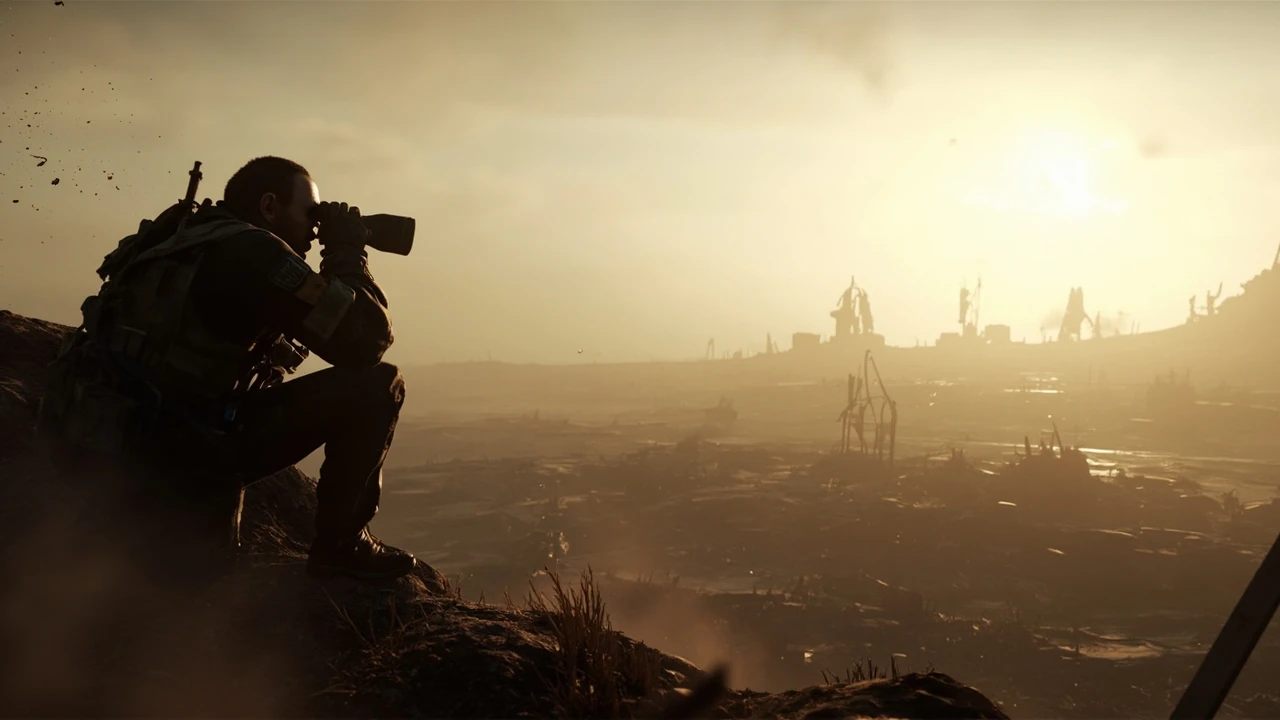
Combat recon in ARC Raiders: how to read a fight before you take it
Combat recon in ARC Raiders is the habit of forcing yourself to gather information before, during, and after a firefight, so each engagement is a decision rather than a reflex. ARC Raiders is built around a world filled with automated machines that patrol, react, and escalate, and the designers have openly framed the title as an extraction-style shooter where information is the resource that decides whether a squad lives long enough to leave the map with their loot. In the May 2025 hands-on preview of ARC Raiders at Game Informer, the writer described the loop as “the most promising extraction shooter” they had played, in part because reconnaissance is treated as a first-class activity rather than a side action, and the preview noted that squads who spent time observing the field before committing usually came out ahead of squads that pushed spawn-to-spawn.
For a player, the practical question is simple: what should you actually be checking, in what order, and what is worth ignoring? The rest of this article walks through that workflow. It treats combat recon as a sequence of pre-engagement checks, an in-fight information cycle, and a post-fight review, with concrete examples of the kinds of threats ARC units create and the kinds of mistakes that a careful squad can avoid. Where the topic is genuinely uncertain, such as the exact behavior of specific ARC classes after a recent patch, the article flags the gap instead of inventing a rule.
Why reconnaissance matters in this game specifically
ARC Raiders puts players into a hostile landscape patrolled by autonomous machines that the developers have publicly described using the umbrella term “ARC.” According to the public Wikipedia entry for ARC Raiders, the game is developed by Embark Studios and is positioned as a multiplayer extraction shooter set in a world of mechanized threats, which is enough to explain why the standard shooter reflex of “shoot first” usually backfires. When the enemy is a coordinated set of machines rather than a few human NPCs, blind engagement tends to attract a patrol, which then escalates into a larger response, which in turn pulls in a third wave from a flank the player never checked. The “fight” is rarely the encounter the player chose; it is the encounter the player accidentally created.
Reconnaissance works as a counterweight to that escalation loop. Each piece of information you collect changes the expected cost of a fight. If you know an ARC patrol is roughly forty meters west, you can plan a route that avoids it. If you know it is patrolling on a fixed timer, you can pick a window. If you know it is broadcasting to other ARC units, you can decide that the loot in the area is not worth the noise. The aim of combat recon is not to make fights easier; it is to make the decision to fight or not to fight accurate.
This is also why reconnaissance is a habit and not a single action. A single binocular sweep is useful but it is also brittle. Patterns break when a new ARC class enters a zone, when a downed player revives mid-patrol, or when an extraction timer changes the movement of every other squad. Good combat recon is built from small, repeatable observations that a player can stitch into a mental map of the field.
The pre-engagement checklist
Before committing to a fight, a useful mental flow looks like this. The list is ordered roughly from cheap information to expensive information, and skipping a step usually means paying for it later in ammo, health, or time.
- Glance at the immediate terrain within about ten meters for cover positions, sight lines, and the nearest hard wall you can put your back against.
- Scan mid-range, roughly ten to fifty meters, for the silhouettes of ARC units and for any movement that does not match the wind or the local wildlife.
- Look outward, beyond fifty meters, for sources of escalation such as heavy ARC silhouettes, anti-air positions, or structures that look like they were built to relay targeting data.
- Listen for the audio cues that often accompany ARC behavior, including the mechanical hum of idle units, the change in pitch that signals a unit is locking on, and the deeper tone that often precedes a coordinated response.
- Check the squad state, including ammunition, healing, stamina, and any utility that is on cooldown, because the cost of a fight is meaningless without the resources to absorb the cost.
- Check the match state, including the timer, the nearest extraction point, and whether other squads are likely to be drawn in by the same target.
The list is deliberately mundane. Reconnaissance in ARC Raiders is rarely a heroic moment of perfect awareness. It is the boring discipline of running the same checklist each time, and then running it again when the situation changes.
Threat categories and what to look for in each
Not every ARC unit asks the same question of the player. The official material so far, including the Game Informer preview, describes the threat environment as a mix of patrol units, heavier combat units, and more specialized classes that can disrupt a squad’s plan in specific ways. Without inventing details that have not been publicly documented, it is fair to describe the broad categories and the kind of recon each one rewards.
Patrol units
Patrol units are the workhorse threats that keep the world moving. They are usually the first to spot a player and the first to call in reinforcements. The recon question for patrols is: how predictable is this patrol? A patrol on a fixed loop is a timing problem and can be avoided with patience. A patrol that investigates disturbances is a noise problem and forces you to manage every gunshot, ability, and dropped magazine. A patrol that responds to line of sight is a sight-line problem and pushes you to favor terrain that breaks silhouettes.
Heavy combat units
Heavy ARC units are the ones that convert a small mistake into a serious one. Recon against heavies is less about the unit itself and more about the surroundings: the walls that can be used as cover, the elevation that lets the heavy’s weapons do less work, and the exits that allow a clean disengage. If a heavy unit is in the area, the recon checklist needs an additional question: is there an exit that does not cross another patrol?
Specialized classes
Specialized ARC classes are the wild card. They tend to disrupt a specific plan, such as a unit that suppresses an area, a unit that interferes with electronics, or a unit that punishes groups. The honest truth is that a full, public behavioral breakdown of every ARC class is not something this article can guarantee. The public ARC Raiders preview and the public marketing material describe the variety of threats but do not give a definitive table of every class and every counter. For the recon workflow, the right habit is to treat any ARC class you have not personally engaged as a question mark, to engage it the first time from a position of maximum safety, and to update your mental model after each encounter.
How to read a fight once it has started
Reconnaissance does not end when the first shot is fired. The in-fight information cycle is shorter and noisier, but it is also where most of the avoidable deaths happen. The useful structure is to think in three horizons: the next ten seconds, the next minute, and the rest of the engagement.
For the next ten seconds, the questions are practical and immediate. Where is the threat right now? Is the squad in cover, in the open, or in a position where the cover can be flanked? Is the engagement creating noise that will attract another patrol? These questions are usually answered by the player’s eyes and ears rather than by any tool, and they are the questions most likely to be skipped when adrenaline is high.
For the next minute, the questions shift to pattern. How is the threat moving? Is it cycling between cover and open ground, or is it holding a fixed position? Is it calling in help, and if so, from which direction? Is the squad burning more healing than the loot in the area is worth? A squad that answers these questions honestly is usually a squad that decides to extract with partial loot rather than dying with full bags.
For the rest of the engagement, the questions become strategic. Should this fight escalate into a longer brawl, or should the squad commit to disengaging? Does the current position defend against the next wave, or is it a kill box once a heavier unit arrives? A useful test is to ask: if a heavy ARC unit appeared in the next thirty seconds, would the current position still be defensible? If the honest answer is no, the squad is already losing the engagement, regardless of how much health the threats have lost.
Recon tools and how to use them
ARC Raiders gives the player several ways to gather information without committing to a fight, and each one rewards a slightly different habit. The following table summarizes the practical use of the common recon tools. Where the precise in-game name or mechanic has shifted in a recent patch, the article flags that uncertainty rather than guessing.
| Tool or method | Best used for | Limitation to plan around |
|---|---|---|
| Binoculars or optical sight | Long-range scanning for ARC silhouettes, extraction traffic, and other squads | Often requires you to remain stationary and exposed while scanning |
| Listening from a covered position | Picking up audio cues about patrol direction, patrol count, and unit type | Audio cues can be masked by wind, gunfire, or environmental noise |
| Indirect observation through a path or a doorway | Confirming a patrol’s reaction to a disturbance without exposing yourself | Observations from a single vantage point can mislead about coverage |
| Marking a target for the squad | Synchronizing a plan, including focus fire, disengage order, or hold position | Marks are useful only if the squad agrees on the meaning of each mark before the fight |
| Using deployable sensors or scouting tools | Watching a flank or a chokepoint while the squad moves | Deployables can be destroyed, can run out of charge, and can be triggered by ARC patrols |
| Checking the map or match interface | Reading the timer, extraction points, and known high-traffic zones | The map cannot tell you what is on the other side of a wall or a ridge |
The most common mistake with recon tools is to use them as a substitute for thinking. A binocular sweep that returns “nothing visible” is not the same as confirmation that the area is empty; it is confirmation that nothing was visible from that angle, at that moment, in those lighting conditions. Combat recon in ARC Raiders improves faster when each tool is paired with a specific question, and when the absence of an answer is treated as data rather than as a clean bill of health.
Working as a squad: who scouts, who watches the rear
In a squad of three, reconnaissance is easier because the labor can be split. In a duo, it is harder because each player is responsible for more of the field. In a solo run, the player has to do all of it, which is one reason solo play in extraction-style shooters is usually slower and more deliberate. The roles that work in practice are roughly the following.
- Spotter: the player who carries the long-range optics and whose job is to call targets, call movement, and call disengage. The spotter is rarely the first to shoot.
- Anchor: the player who holds the rear or the flank, watches for escalation, and decides whether the squad should commit, hold, or pull out. The anchor’s value is the option to leave cleanly.
- Mover: the player who handles the mechanics of the squad’s plan, including looting, deploying utility, and physically taking the position. The mover is usually the one who is exposed the most and therefore needs the most protection.
These roles do not have to be fixed for an entire run. The spotter in one fight can be the anchor in the next, especially if the engagement has moved to a different part of the map. What is fixed is the idea that one player is responsible for the question “what is happening that we have not yet engaged” and another is responsible for the question “what is happening behind us that we have not yet noticed.” A squad that does not assign these roles usually ends up answering both questions badly.
Patrols, escalation, and how to avoid the second wave
Escalation is the part of the combat recon loop that costs new players the most runs. A single fight is rarely the problem; the second wave that arrives while the squad is looting, reviving, or healing is. A useful mental model is that each engagement has a noise budget, and the budget is consumed by gunfire, by certain abilities, by reviving, and sometimes by movement. Reconnaissance helps a squad forecast how much budget is left and when a second wave is likely to arrive.
A practical way to keep the budget honest is to treat the first thirty seconds of any fight as a free window. For additional context, Most ARC patrols do not reinforce instantly; there is a brief period in which the squad is free to take a fight, take a position, and prepare for the next wave. After that window, the probability of reinforcement rises sharply. The recon question is therefore not “is this fight winnable” but “is this fight winnable before the second wave.” If the answer is no, the right move is usually to extract and reset rather than to commit.
Reading other players, not just ARC units
ARC Raiders is a multiplayer game, and the most dangerous escalation source is often a human squad that heard the same gunfire. The same recon checklist applies, with two adjustments. First, human players are less predictable than patrols and more likely to bait an overcommit. Second, the cost of being wrong is asymmetric; a squad that mistakes a lone looter for an ambush tends to lose the engagement, while a squad that treats a real ambush as a looter tends to lose the run. The safer default is to assume human contact is more dangerous than it looks, especially in the late stage of a match when extraction traffic is highest.
Recon against players is also where listening matters most. A squad that is pushing in your direction often betrays itself with footstep patterns that are not quite right, with the wrong kind of weapon handling noise, or with a flashlight at the wrong moment. Treating every sound as a question and not a fact is a habit that pays off across many matches, not just one.
What to do with information after the fight
Combat recon in ARC Raiders improves the most when the player treats each fight as a data point. The post-fight review is not a metaphor; it is a concrete habit of asking four questions. Did the fight go the way the recon predicted? If not, what was missed and why? What new information does the squad have now that it did not have before the fight? Does the squad’s loadout match the kind of fight that just happened, or is there a mismatch that should be corrected before the next match?
These questions are deliberately short. The point is not to produce a tactical essay after every engagement. The point is to commit one observation to memory, and to do it consistently. Over a few runs, a player who keeps the post-fight review will notice patterns that other players do not: that a particular ridge always has a patrol at a particular minute, that a particular approach tends to be watched from a particular window, that a particular heavy unit responds to a particular sound. None of that knowledge is useful in the moment it is learned; all of it is useful the next time the squad faces the same situation.
Common recon mistakes and how to avoid them
The same mistakes show up in most early runs. Naming them directly is faster than describing them abstractly.
- Confusing a clean binocular sweep with safety. A sweep covers one angle at one moment; safety requires the whole area over time.
- Committing to a fight because the loot looks valuable, before the recon checklist has been run. The cost of a fight is not just the fight itself; it is the second wave, the missed extraction, and the lost run.
- Splitting the squad across two sight lines during a recon. Two sight lines are useful only if the squad has agreed in advance who covers which and how they will call targets.
- Failing to mark targets, so the squad ends up shooting at the wrong ARC unit and letting the right one flank.
- Ignoring audio cues while running, because footsteps and patrol hum are drowned out by the player’s own movement.
- Treating extraction as a victory lap. The most dangerous part of many runs is the last thirty seconds before extraction, when a careless push is most tempting.
Avoiding these mistakes is mostly a matter of attention. The player who runs the checklist and then runs it again, even when the engagement feels easy, is the player whose runs last longer than average.
Reconnaissance in different phases of a run
The early, middle, and late phases of an extraction run ask different things of the player’s recon discipline. The following table summarizes the practical differences. It is intentionally conservative; if a future patch changes the timing of these phases, the underlying habits still apply.
| Phase | Primary recon goal | Common failure mode |
|---|---|---|
| Early run | Map control: learn patrol routes, locate safe cover, identify the first source of high-value loot | Rushing toward loot without reading the patrol layout |
| Mid run | Engagement selection: pick fights that the squad can win before escalation | Taking every contact rather than choosing contacts |
| Late run | Extraction safety: control sight lines around the extraction zone, manage noise, and avoid overcommitting | Treating extraction as automatic rather than as the most contested part of the run |
The phases are not hard walls. A squad that has already chosen its extraction point by the mid run can be more selective about mid-run engagements, and a squad that has ignored extraction safety until the late run is usually fighting uphill against both the map and the timer.
Recon, loadouts, and the cost of information
Some loadouts are built to maximize information. A long-range optic, a quiet movement tool, and a utility that reveals a small area can be thought of as a recon loadout, even if it does not look like one on paper. Other loadouts are built to win a specific kind of fight, and their recon value is limited. The honest tradeoff is that a squad built entirely for recon will not be able to win every engagement it stumbles into, while a squad built entirely for combat will stumble into more engagements than it should.
A useful balance is to keep at least one slot, often the optic, the sensor, or the scouting tool, dedicated to information. The marginal cost of that slot is usually one offensive tool, but the gain in the quality of the squad’s decisions is often larger than the loss in raw firepower. The exact tradeoff depends on the squad’s playstyle, but the principle generalizes: a squad that cannot see the field cannot choose its fights, and a squad that cannot choose its fights pays for the choice in respawns.
Limitations of this article
ARC Raiders is a live game in active development, and several pieces of information that a player might reasonably want are not yet public in a form this article can verify. The article does not pretend to know the exact behavior of every ARC class, the exact balance of every weapon, the exact timing of every patrol, or the exact layout of every map. Where the public material, including the ARC Raiders preview at Game Informer, provides a useful description, this article has used it. Where the public material is silent, this article has flagged the gap rather than invented a rule. Players who want the most current picture should treat this article as a workflow and a set of habits, and should check the official channels and community resources for changes after each patch.
Frequently asked questions
What is combat recon in ARC Raiders in plain terms?
Combat recon in ARC Raiders is the habit of gathering information about the field before, during, and after a fight, so that each engagement is a decision rather than a reflex. It includes pre-fight scanning, in-fight information checks, and a post-fight review.
Do I need a binocular to do combat recon well?
No. A binocular is one of several tools and it is most useful for long-range scanning. Most of the work is done with the player’s eyes, ears, and squad communication, and a squad that relies on a single optic will miss the audio cues that often tell the real story.
Is ARC Raiders only about fighting ARC units, or are there other threats?
ARC units are the headline threat, but the game is multiplayer, which means other squads are also a source of escalation. Reconnaissance has to account for both the automated patrols and the human players who may be drawn to the same loot.
How does the extraction-style loop change recon priorities?
Extraction-style play pushes the squad to think in terms of the cost of a fight, including the noise, the time, and the missed extraction, rather than just the local outcome. Recon priorities therefore include escape routes, escalation risk, and the match timer, not only the immediate sight lines.
What is the most common recon mistake new players make?
Confusing a clean sweep with safety. A single binocular scan confirms what was visible at one moment from one angle; it does not confirm that the area is empty. Players who treat the absence of a contact as a clean bill of health tend to be caught by the second wave.
How should a solo player adapt combat recon?
Solo play usually demands slower movement, more reliance on cover, and a stronger bias toward avoiding patrols rather than fighting them. The same checklist still applies, but each step has to be done by one player rather than split across a squad, so the cost of skipping a step is higher.
Does combat recon change in the late phase of a run?
Yes. The late phase, especially around extraction, is the most contested part of most runs. Recon in the late phase prioritizes sight lines around the extraction point, the noise budget of the squad, and the location of any human contacts who may be moving toward the same exit.
What is the role of audio in combat recon?
Audio is often the first signal of a threat, especially one that is not yet in line of sight. Listening from a covered position can confirm a patrol’s direction, count, and behavior in ways that a visual scan cannot, and it does not require the player to expose themselves.
How do I keep the squad coordinated during a recon sweep?
Assign the roles in advance: who is spotting, who is anchoring, and who is moving. Agree on the meaning of any marks or callouts before the fight starts, and review what the squad learned after the fight so the next run is better coordinated than this one.
Where can I read more about the game’s design intent?
The May 2025 hands-on preview at Game Informer is a useful starting point, and the public Wikipedia entry for ARC Raiders gives a broader overview of the studio and the genre positioning. Treat both as the public, verifiable baseline and check the official channels for any post-patch updates.

Leave a Reply